
DICTIONARIES
'What a comfort a dictionary is!'
-Lewis Caroll

What are dictionaries?
By consulting the Oxford English Dictionary, we can simultaneously retrieve a definition and demonstrate the usefulness of dictionaries:
"A book which explains or translates, usually in alphabetical order, the words of a language or languages (or of a particular category of vocabulary), giving for each word its typical spelling, an explanation of its meaning or meanings, and often other information, such as pronunciation, etymology, synonyms, equivalents in other languages, and illustrative examples." (Dictionary, n.d.)
In other words, a dictionary translates or provides a brief explanation of a word, and possibly other information — as wonderfully demonstrated above by the Oxford English Dictionary!
TYPES OF DICTIONARIES
Dictionaries come in both digital and print form, with many dictionary publishers of well-known print dictionaries opting to publish their dictionaries in both formats.
Dictionaries are also capable of achieving a surprising amount of specificity and may even encroach on the territory of enclyclopedias, although with less depth. (Cowie, 2009) Here is a small selection of the types of dictionaries available:

Business dictionariesBilingual, trilingual, or translation dictionariesChildren's dictionariesRhyming dictionariesThe Devil's Dictionary (a satirical dictionary)Oxford Dictionary of World Religions
Yadgar Dictionary of Computer and Internet TermsEncyclopedia dictionaries (a hybrid of two reference resource classes)Electronic dictionaries (portable devices with keyboards for searching word definitions, often used by second language learners)
CHARACTERISTICS & FORMATTING
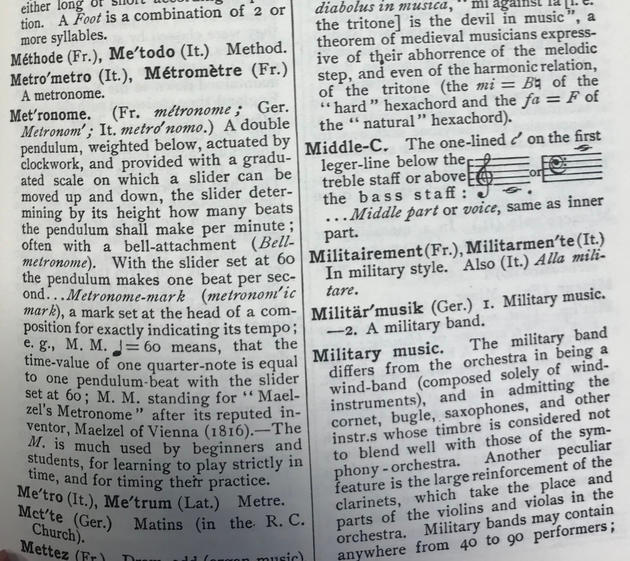
A musical dictionary with definitions, musical notation, translations, origin country of the term, notation examples & more.
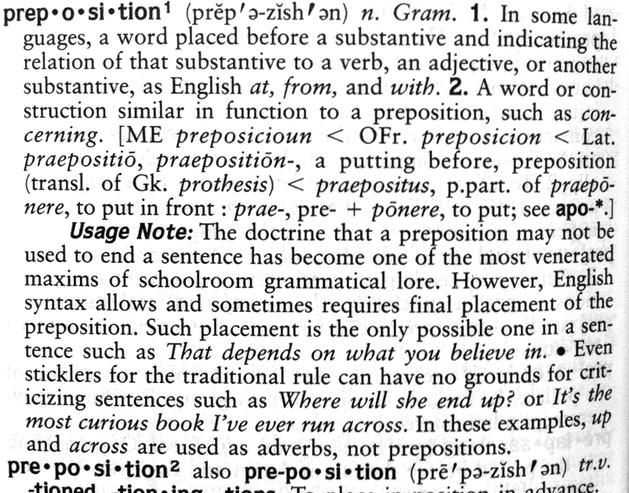
An English-Language dictionary with definitions, pronunciations, word class, etymology, examples and usage notes.
While there are a variety of dictionaries, they tend to maintain some similar characteristics:
The most defining feature of dictionaries is that they are ordered alphabetically, or by the common sound/character ordering for the relevant language. The first and last word on each 2-page spread is listed in the upper corners of each page (first word on the left page, last word on the right page in left-to-right languages) to indicate the range covered on the spread.Many will contain a user guide to explain abbreviations and other idiosyncrasies particular to that dictionary.They will often contain additional information at the word level such as pronunciation (often in IPA), word class and alternate spellings, particularly for language dictionaries. Optionally, translations and etymological roots may be provided.On the semantic level, they will often provide examples (whether in sentences for a language dictionary or perhaps an illustration of the appropriate musical notation in a musical dictionary) or list similar terms/synonyms.Print dictionaries can be single volume and compact, or multi-volume, and massive. In fact, they may be HUGE to the point where they are difficult for patrons with strength or mobility issues to manipulate. This variation is also reflected in cost: the 20 volume hardcover set of the Oxford English Dictionary is presently $1,050+ on Indigo Books, while the smaller paperback edition is a mere $15. And of course, the Oxford English Dictionary website is available for free.

Dictionary Deep Dive: Yasuo Nakamura's The English-Japanese Literary Translation Dictionary
Format: Print only (Softcover)
Year: 2002
Cost: ~$60 (via Amazon.co.jp)
Availability: Available for purchase via Amazon.co.jp but difficult to find through other suppliers shipping outside of Japan.
This dictionary is a single-volume Japanese-language dictionary by Yasuo Nakamura, the translator of over 100 works of literary fiction (primarily mystery and sci-fi) into Japanese. This dictionary serves as a resource for those looking to translate English terms into Japanese in a smooth, natural way, primarily in the field of literary translation.
This text provides several translation strategies and solutions for English to Japanese translators from the literary field, rather than context-less, one word translations one would expect to see in a standard bilingual dictionary. This book is very much intended specifically for translators and Japanese speakers with incredibly high levels of English skill -- those simply trying to learn English will likely be frustrated by its complexity and specificity.
The example sentences used are from published literary works by native English speakers and their Japanese translations by Nakamura or his peers, which enhance its credibility and uniqueness (although the source titles are never provided!).
Each definition is generally intended to fill the gaps found in standard English-Japanese dictionaries. Whether it is in the form of a convenient hypernym or hyponym, or metaphorical uses of a word (e.g. "bowels" to mean "depths"), Nakamura's examples and translations are a great reference for current or aspiring English-Japanese translators. That said, there is a considerable amount of unpredictability in what types of terms are included and what types of terms are not -- this book will not replace anyone's standard, catch-all bilingual dictionary, but rather supplement it.
LImitations & usefulness
Dictionaries are best for patrons who are seeking a quick, basic introduction to a concept, or need clarification about the meaning or multiple meanings of a word. They are especially useful for patrons who may have multiple inquiries of this variety.
The dictionary is valuable as a supplementary reference resource for both librarians and patrons. Having a medical dictionary nearby while exploring articles for a student can help illuminate the librarian who is unfamiliar with the field. It is also the beloved companion of language learners, who may need it for reading, writing, and making reference requests in non-native languages.
On the other hand, dictionaries are not ideal for patrons who are looking for large amounts of in-depth information about a concept. A dictionary will not help experts looking to deep-dive or students wanting to write whole papers about a specific topic.
Dictionaries are also best for fairly precise "what", "where", and "which" questions — "how", "why" and "who" may be better served by other reference resources. They are also unhelpful for patrons who may know the concept or definition, but not the necessary keyword required to look it up in a dictionary. (e.g. "What do you call a guitar that's not electric?")

Rating Dictionaries as a Reference
Ease of Use: ★★★★☆
(Requires the patron to know the exact keyword or term with correct spelling, but most dictionaries only require the keyword + an understanding of alphabetical ordering.)
Speed Factor: ★★★★★
(Provides an at-a-glance definition of a word or concept, providing a near instant response for patrons who require a simple definition.)
Accessibility: ★★★☆☆
(Basic dictionaries are easily accessed online, but some dictionaries are print only and may be prohibitively hefty both in terms of weight and price. Specialized dictionaries are also harder to locate.)
Depth: ★☆☆☆☆
(Extremely generalized unless a specialized dictionary is used, and even then it may be quite simple or broad.)
Reliability: ★★★★☆
(Dictionaries generally provide unbiased, factual information, although rare exceptions do exist.)
References:
Atkins, S. (1998). Using dictionaries: Studies of dictionary use by language learners and translators. Tübingen: Niemeyer.
Béjoint, H. (2004). Modern lexicography: an introduction. Oxford: Oxford University Press.
Cowie, A. P. (2009). The Oxford history of English lexicography. Oxford: Clarendon Press.
Dictionary. (2018.) Encyclopedia Britannica online. Retrieved from https://www.britannica.com/topic/dictionary
Dictionary. (n.d.) In Oxford English dictionary. Retrieved from https://en.oxforddictionaries.com/definition/dictionary
Nakamura, Y. (2002). The English-Japanese Literary Translation Dictionary. Tokyo: Kenkyusha.
Site by Emma U. for LIS 503 @ UofA.